Digital assets
A Crypto Crime Has No Address. So Which Court Gets to Judge It?
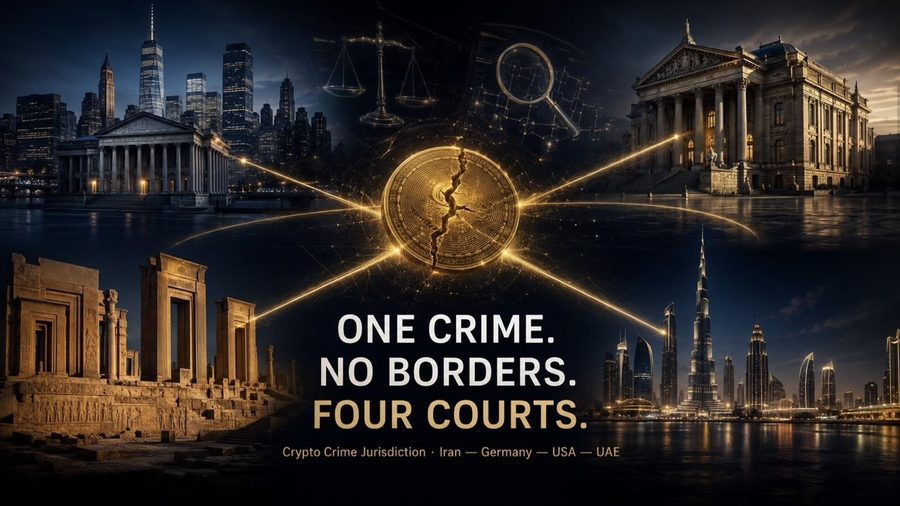
A hacker in one country drains a victim's wallet in a second, through an exchange in a third, moving coins across a dozen servers. A theft happened — but where, legally, did it happen? That question decides which police can investigate, which court can rule, and whether the victim sees redress. Traditional law was built for crimes with a physical location. Crypto has none.
Here is how four systems answer it.
The two tools every system reaches for
Almost every system leans on two principles. Territoriality: a state can judge a crime on its soil — where the act began, or where the harm landed ("effects" doctrine). Nationality: a state can claim a crime by, or against, its citizen. Crypto breaks both — act, harm, and actors sit in different places at once. The result: overlapping jurisdiction.
United States — the long reach
The US formally presumes its laws stop at its border, but in practice its reach is vast: if a US-incorporated exchange, server, or victim is involved, American courts can assert jurisdiction under the effects doctrine. Because so much crypto infrastructure touches the US, few serious cases are truly beyond it.
Germany — territorial, with effects
German criminal law is primarily territorial (§§ 3–7 StGB): a crime counts as committed in Germany if the act or result occurred there. If a German victim suffers the loss, that "result on German soil" can ground jurisdiction — even if the perpetrator never entered the country. Nationality extends it further in defined cases.
UAE — territorial and protective
The UAE asserts jurisdiction over offences on its territory, and its cybercrime law reaches conduct targeting UAE systems, institutions, or victims — a protective logic. With Dubai now a major crypto hub, more cases carry a genuine UAE nexus than one might expect.
Iran — territorial and personal
Iranian law applies to crimes on Iranian territory, and extends via the nationality principle to certain acts by Iranian citizens. But a further layer complicates any Iran-linked case: sanctions and restricted cooperation channels can make cross-border evidence-gathering far harder than the rule suggests.
Why overlap is the real problem
In one theft, the US, Germany, the UAE and Iran could each claim a legitimate stake — victim here, exchange there, coins everywhere. The question is rarely "does a court have jurisdiction?" It is "which of several does — and will they cooperate?" That cooperation runs through slow mutual-legal-assistance channels, and where sanctions intervene, it can stall entirely.
The lesson mirrors all cross-border law: the asset moves in seconds, justice at the speed of the slowest treaty. Knowing in advance which systems your crypto touches is not paranoia — it is the difference between a claim you can pursue and a loss you absorb.
##Crypto CrossBorder Jurisdiction ARIKEH