From practice
You Don't Need a Flight to Iran. You Need the Right Signature.
An inherited apartment in Tehran you can't sell. A court case you can't attend. A document a German authority wants "legalised" — from 4,000 kilometres away, in a system you can no longer walk into.
Most people assume this means booking a flight, or letting the matter rot. Both are wrong. The real answer is narrower, and almost nobody gets told how it actually works.
First: two different doors, not one
People lump "giving power of attorney" into a single act. It isn't.
For litigation, an Iranian lawyer can represent you through SANA — Iran's official electronic judicial system — activated by an Iranian phone number that receives the confirmation SMS. No consulate visit, no wet-ink trip. The case moves while you stay in Europe.
For everything else — selling property, inheritance, registrations — the authority comes from a notarised power of attorney issued at an Iranian consulate or embassy abroad. You sign in Berlin or Frankfurt; it holds in Tehran.
Two matters, two mechanisms. Confuse them, and you lose weeks.
The part that changes everything: one mandate, a whole team
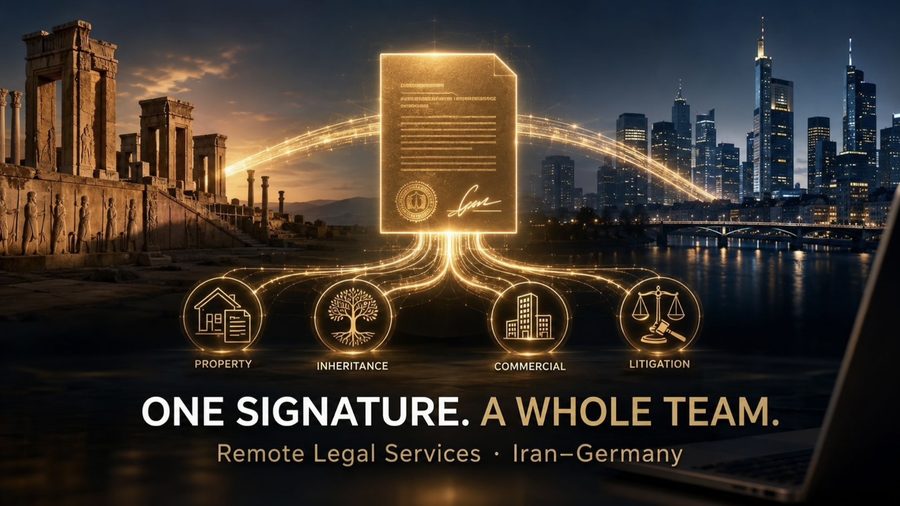
Here is what most clients never realise. A power of attorney to the right lawyer is not access to one person — it is access to a network. Through substitution, that mandate can be delegated to the specialist the matter actually needs: an inheritance lawyer for the estate, a property lawyer for the deed, a commercial lawyer for the company.
You sign once. Behind that signature stands whichever expertise the case demands. You are not hiring a single pair of hands — you are appointing a coordinator with a bench.
Where remote matters actually fail
Almost never on the law. They fail on the seams. A power of attorney drafted too narrowly to cover what's needed. A translation the court rejects. A name spelled differently than on the deed. A signature legalised for one country but not the other. Each looks trivial. Each costs months.
What makes it work
Not proximity — coordination. Someone who sees both ends: what the Iranian office requires, what the German authority accepts, which specialist the file needs, and how to build every document so it holds on both sides the first time. The value isn't standing in a Tehran courtroom. It's making sure nothing you send ever has to be sent twice.
Living abroad doesn't mean losing what you left behind. It means your matter now lives between two systems — and has to be run that way.
The distance was never the hard part. The gap between the systems is. That's what needs a bridge.
##RemoteLegal IranianLaw CrossBorder PowerOfAttorney ARIKEH