Succession and assets
An Iranian-German Family's Wealth Doesn't Die with Them. It Fragments.
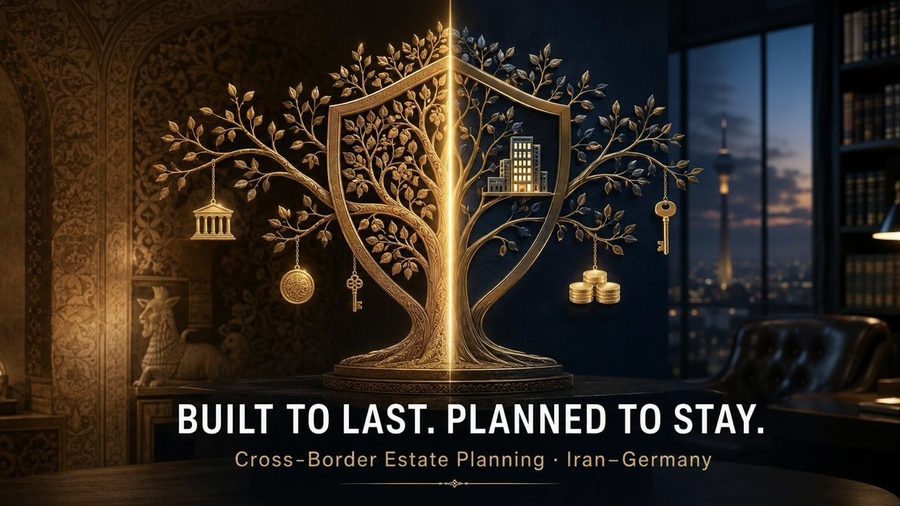
A family builds a life across two countries. An apartment in Tehran. A company and a home in Germany. Investments, perhaps some crypto. Then the founder passes — and the wealth that took decades to build begins to splinter across two legal systems that were never designed to talk to each other.
This is the quiet crisis of cross-border family wealth. The good news: German law offers real tools to prevent it — if they are put in place early.
What actually happens on death
German assets fall under German and EU succession law. Under the EU Succession Regulation, the law of the deceased's habitual residence generally governs the estate — but property located in Iran does not follow that rule. Iranian real estate stays under Iranian law (lex rei sitae). The result: one family, two parallel succession proceedings, and heirs caught between them.
Add to this the Pflichtteil — the compulsory share German law guarantees to close relatives regardless of the will — and a plan that looks clean on paper can unravel fast.
The German toolbox — and what each tool does
German law gives families more options than most realise:
Family Foundation (Familienstiftung): holds assets as one unit across generations, preventing fragmentation and shielding wealth from third-party claims. Powerful — but it triggers inheritance/gift tax on funding, and a "substitute inheritance tax" every 30 years. Not a loophole; a structure.
Inheritance Contract (Erbvertrag): a binding, notarised agreement that can also fix which country's law applies — unlike a will, it cannot be changed unilaterally.
Usufruct (Nießbrauch) and trans-mortem power of attorney (transmortale Vollmacht): allow control and income to pass smoothly without freezing the estate.
Long-term executorship (Dauertestamentsvollstreckung): keeps assets managed and protected for years after death.
Where the two systems meet — the real work
Here is the catch: none of these German instruments reach into Iran. A German foundation cannot simply absorb Tehran real estate. An Erbvertrag drafted only under German law may say nothing useful about the Iranian side. The Iranian assets need their own lawful, documented path — and the two structures must be designed to fit together, not collide.
This is exactly where one legal system is never enough. German estate planning handles the German half beautifully. The Iranian half needs Iranian-law competence built into the same plan. The value is not the foundation itself — it is making the German structure and the Iranian reality speak with one voice.
For an Iranian-German family, succession planning is not a document. It is the difference between leaving a legacy, or leaving years of cross-border litigation.
The time to build it is now, in calm. Not later, in court.
##EstatePlanning Familienstiftung CrossBorder IranianLaw ARIKEH