Succession and assets
In the UAE, Your Family Doesn't Inherit Your Wealth. They Inherit a Frozen Account.
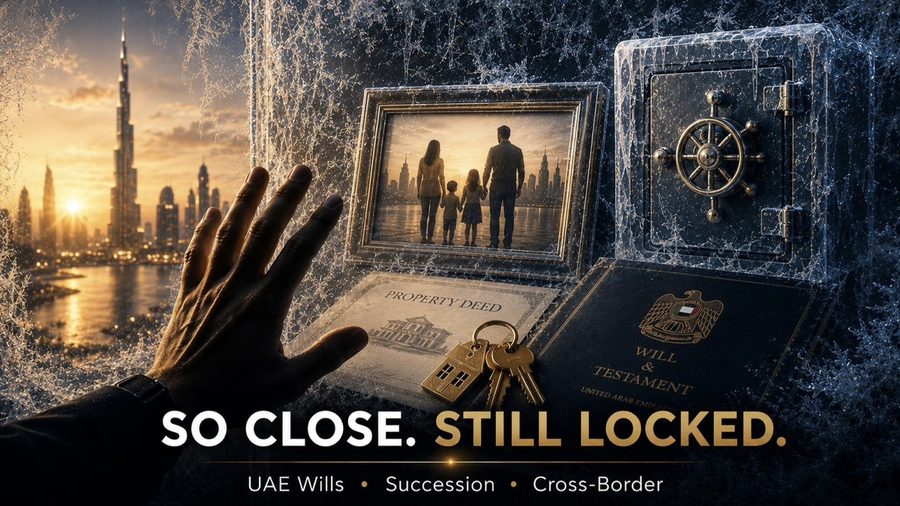
You spent years building it. Property. Company shares. A bank balance that took a lifetime to fill. Then one phone call — and your family discovers they cannot touch a single dirham of it.
Welcome to the most expensive assumption foreigners make in the UAE: "My home country's law will protect my assets here." It will not. And the day they learn that is the worst possible day to learn it.
The myth that costs families everything
A will in Germany, Iran, India — anywhere — does not automatically govern your assets inside the UAE. Die without a UAE-registered will, and the statutory succession framework applies instantly. Your foreign documents do not step in. They wait in line.
What actually happens at death
Every UAE asset — bank accounts (sometimes even joint ones), real estate, business interests — is frozen the moment the institution learns of the death. No withdrawal. No transfer. No sale. Nothing moves until a court issues a succession order. For a business owner, that freeze stalls licence renewals, supplier payments, and payroll. Your estate doesn't pass to your family. It passes into a months-long process.
The 2026 change few are talking about
Under the reform effective in 2026, if a foreign resident dies with no valid will and no identifiable heirs, their UAE assets become a charitable endowment (waqf), managed by the authorities. Socially constructive — and potentially the exact opposite of what you intended.
Where this meets the new Civil Transactions Law
This is no isolated rule. It moves in lockstep with the new UAE Civil Code (in force June 2026): toward transparency and documented clarity. Banks, registrars, and asset managers now demand clear succession arrangements — especially where ownership runs through individual shareholders. Estate planning has quietly become a compliance expectation, not a preference.
The sharper edge — cross-border families
When wealth spans two systems — assets in the UAE, roots in Iran, heirs in Europe — the exposure multiplies. Every foreign document must be legalised and translated into Arabic before a UAE court will even look at it. A father reaching a deceased child's estate from abroad can lose months assembling proof the court accepts. The paperwork that saves your family must exist before it is needed — afterward, it is too late.
Here is the truth most avoid: in the UAE, doing nothing is itself a decision. It hands your life's work to a statutory formula, a frozen account, and a courtroom — none of which know your wishes, or will ask.
A registered UAE will is not paperwork for the wealthy. It is the single line between your family inheriting your wealth — or inheriting your problem.
If your assets touch the UAE, this is not next year's task. It is this year's.
##UAE EstatePlanning Wills Compliance CrossBorder ARIKEH