Succession and assets
For Dual-National Families, a German Foundation Is a Powerful Tool — and a Trap If You Misuse It
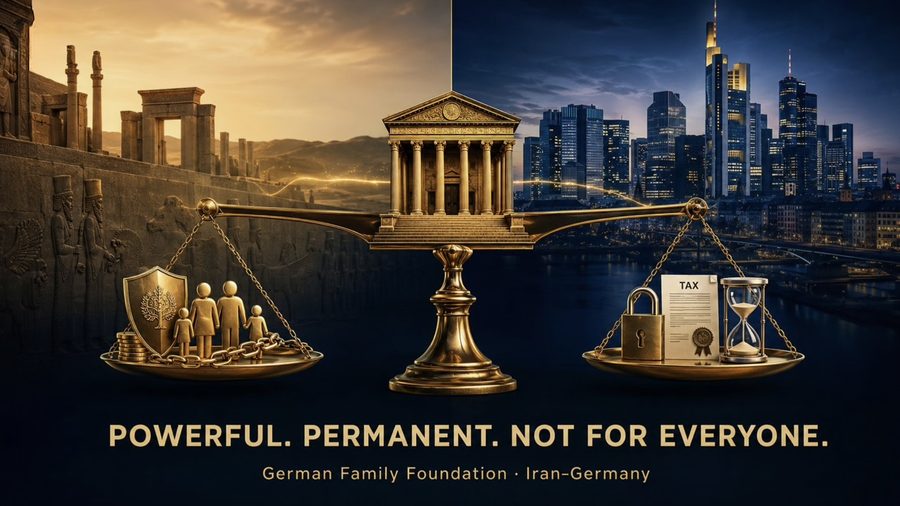
An Iranian-German family — a company in Germany, property in Tehran, children with two passports — eventually asks: how do you keep wealth from fragmenting across borders and generations? One answer keeps surfacing: the German family foundation (Familienstiftung). It deserves a clear-eyed look, not a sales pitch.
What it actually is
A Familienstiftung (§§ 80–88 BGB) is a legal entity with no owners or shareholders. Assets placed into it belong to no individual — only to its purpose: keeping wealth whole across generations.
The advantages
Anti-fragmentation: the estate does not split among heirs each generation; it stays whole.
Asset protection: shielded from third-party claims and disputes.
Continuity: carries family goals forward regardless of who moves where.
The tax advantage — in numbers
Transferring assets to a legal entity is normally taxed under the harshest bracket — Class III (30–50%, allowance €20,000). A family foundation gets a privilege: it is taxed under Class I (7–30%, allowance up to €400,000), based on the most distant intended beneficiary.
On a €2,000,000 transfer: ~€594,000 tax the ordinary way (Class III) versus ~€304,000 into a family foundation (Class I) — ~€290,000 saved on one transfer. For relocating families, exit-tax (Wegzugsteuer, § 6 AStG) planning can save more by keeping Germany's taxing right intact.
The disadvantages
Expensive: an independent foundation typically needs a large endowment (often ~€1M) plus running costs.
The 30-year tax: every 30 years a "substitute inheritance tax" (Erbersatzsteuer) hits the foundation's assets.
You lose control: once assets go in, they are no longer yours — permanently.
Not a tax trick: authorities reject arrangements built purely to dodge tax; it works only inside genuine, long-term planning.
The comparative catch for Iranian-German families
What a German-only view misses: a Familienstiftung governs German-held assets beautifully — but does not reach into Iran. Tehran real estate cannot go into a German foundation; it stays under Iranian law (lex rei sitae). So a dual-national family needs two coordinated structures: the German foundation for one side, a lawful path for the Iranian side.
A second layer: the children's dual nationality can turn a German-efficient structure into an Iranian-law problem — which is why both systems must be planned together, from the start.
The honest verdict: for the right Iranian-German family — real assets, long horizon, genuine succession goals — a foundation is an excellent anchor. For a short-term or purely tax-driven plan, it is the wrong tool.
Either way, it is never the whole answer — only one half of a structure that works when both sides speak with one voice.
##Familienstiftung EstatePlanning CrossBorder ARIKEH