Digital assets
Your Heirs Can Inherit Your Crypto. They Just May Never Be Able to Touch It.
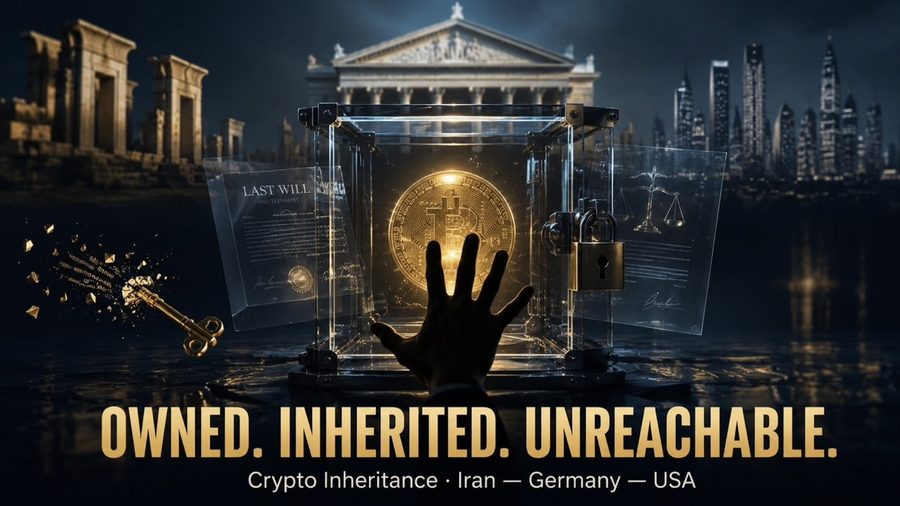
In 2019, the founder of a crypto exchange died suddenly at 30 — taking access to roughly $190 million in crypto to the grave. Not stolen. Not lost in a crash. Simply locked forever, because no one else held the key. This is the paradox of crypto inheritance: the law can say your family owns it, while the asset itself refuses to let them in.
The problem the law can't solve on its own
Every legal system treats crypto as property — ownable, taxable, inheritable. On paper, your heirs inherit your Bitcoin the moment you die. But crypto is a bearer instrument: whoever holds the private key controls it. No bank to call, no "forgot password," no authority to reset access. If your heirs don't have the key or seed phrase, their legal ownership is worthless — they own something they can never reach.
This is what sets crypto apart. A house, a bank account, a company share — all transfer by a court order and a death certificate. A private wallet does not. The court can name the owner; it cannot open the wallet.
Where the legal systems then diverge
Once access is solved, the three systems still treat it differently.
United States: crypto is property (per the IRS), passing by will or trust. The favoured tool is the trust — it holds the asset, avoids public probate, and keeps keys out of a will (a public document). Step-up in basis applies at death.
Germany: no trust exists. Two tools do the work: a Testamentsvollstrecker (executor) can manage the wallet and even restrict heirs' access meanwhile (§ 2211 BGB), and a transmortale Vollmacht — power of attorney valid beyond death — lets a trusted person reach the wallet fast, without waiting for a certificate of inheritance. That speed matters when value swings daily. Crypto still enters the Pflichtteil calculation.
Iran: no trust exists, and a power of attorney lapses on death. But Iranian law has the vasi (testamentary executor) — a person the deceased appoints to administer and distribute the estate, holding the assets as an amin (trusted fiduciary). With a precise will and securely lodged access instructions, the vasi is the closest functional tool. Iran's regulatory posture toward crypto adds further uncertainty.
The cross-border knot
Now imagine an Iranian family: a wallet built in Iran, an heir in Germany, another in the U.S. Three systems claim a say over the same string of code — and none of it matters if the seed phrase died with the owner.
The lesson is unusually blunt for law: the legal right to inherit and the practical ability to inherit are two separate things. Securing one without the other leaves your family a number on a screen they can see and never spend.
Plan the access with the same care as the inheritance. One without the other is not a plan — it is a loss waiting to happen.
##Crypto Inheritance EstatePlanning DigitalAssets ARIKEH