Proving Iranian law
If You Do Not Prove Iranian Law, the Court Will Assume It Looks Like Yours
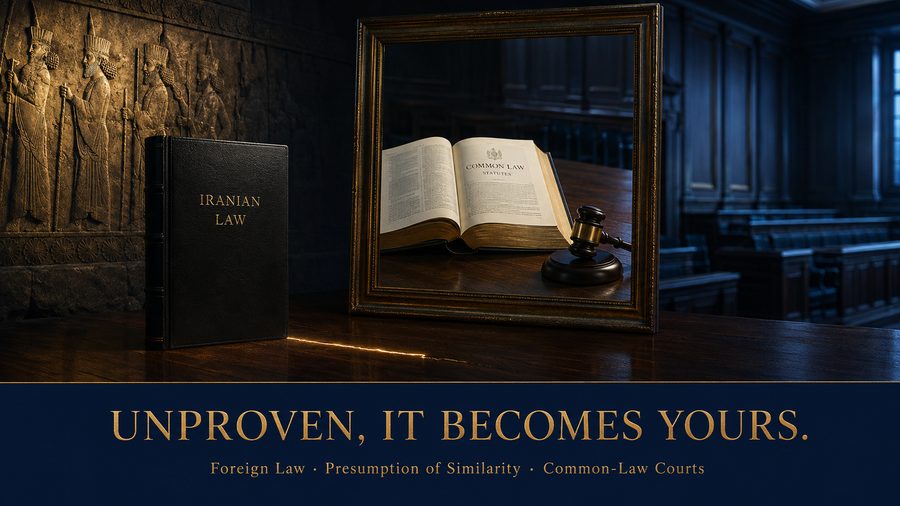
In common-law proceedings, foreign law does not arrive on its own. It has to be raised by a party and established on the material put before the judge. The mechanism differs between jurisdictions, but the consequence does not. Where nobody establishes it, the court does not stop. It falls back on its own law, assuming the foreign law is not materially different.
That assumption is efficient and usually harmless. With Iranian law it is neither.
Mahr
Assume the marriage contract works like a prenuptial agreement, and the mahr becomes an asset to divide or a bargain to test for fairness. It is neither. It vests in the wife at the moment of the contract and stands as a debt owed by the husband. It was never marital property.
Succession shares
Assume testamentary freedom and you identify the wrong heirs. Iranian shares are fixed by law, a will reaches only part of the estate, and the deceased's parents are first-class heirs taking one sixth each even where there are surviving children — a class most common-law systems exclude entirely once there are descendants.
Title
Assume ownership is whatever the register records, and you may be looking at the wrong owner. A great deal of Iranian property sits in unregistered private contracts, or stands in a relative's name for reasons that had nothing to do with the present dispute.
Authority to sign
Assume the signatory could bind the company because of his title. In Iran the scope of a managing director's authority is fixed in the company's own articles and published in the official gazette. A signature outside that scope is not a breach of contract. It is a different problem, with a different remedy.
Divorce
Assume a decree here ends the marriage everywhere. It does not end the Iranian one, which subsists until a separate step is taken in Iran — with consequences for the next marriage, for inheritance, and for civil status.
None of these is exotic. Each turns up in ordinary files, and each is decided silently the moment nobody raises it.
The real risk in cross-border work is not uncertainty. Uncertainty gets noticed, argued and priced. The risk is a confident answer produced by an assumption nobody examined, because no one thought there was anything to examine.
Foreign law does not prove itself. Somebody has to put it in front of the court.
I am an Iranian-qualified attorney based in Düsseldorf and registered here for Iranian legal services. I write opinions and expert declarations on Iranian law for proceedings abroad, and my own office in Iran obtains the underlying records. The local law stays with you.
##IranianLaw ForeignLaw PrivateInternationalLaw ExpertEvidence CrossBorderLitigation Succession ProbateLaw FamilyLaw InternationalArbitration AssetRecovery PrivateClient