Proving Iranian law
Foreign Law Is a Fact in London. In a US Federal Court, It Is Law.
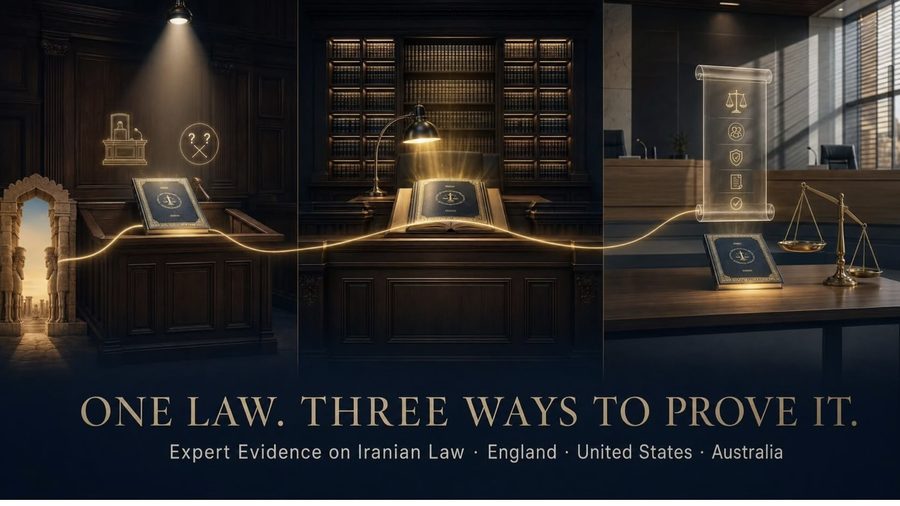
Two firms ask me the same question about the same Iranian marriage contract. Same law, same answer — and two documents that look nothing alike. Not because anything changed between London and New York, but because the two courts do not receive foreign law the same way.
England: your expert is a witness
Foreign law is a question of fact. It has to be pleaded, and it has to be proved — traditionally through expert evidence, because the judge is not expected to read the foreign text unaided. The expert's paramount duty runs to the court rather than to the party paying for the report, and the opinion can be tested in cross-examination.
Australia: the same route, with a written code
Foreign law is again a question of fact proved by expert evidence. The Harmonised Expert Witness Code of Conduct puts it plainly: the expert is not an advocate, and the duty to assist the court impartially overrides any duty to the party who retained them. Instructing solicitors have to keep visible distance from the drafting.
The United States: your expert is closer to an argument
Rule 44.1 of the Federal Rules of Civil Procedure changes the character of the exercise. The court may look at any relevant material or source — including testimony that would not pass the ordinary evidence rules — and its conclusion is treated as a ruling on a question of law, not a finding of fact. The judge may also research the point independently. A declaration that merely asserts is weak. One that hands the judge the primary sources, translated and traceable, is not.
The trap common to all three: silence is also an answer
Where foreign law is pleaded but its content is never proved, an English court may presume it is materially similar to English law until the contrary is shown (FS Cairo (Nile Plaza) LLC v Brownlie [2021] UKSC 45). The Supreme Court added two warnings: relying on that presumption at trial is a precarious course, and it sits most comfortably where the other system is itself a common-law one.
Iranian law is not. Fixed heirship shares, a testamentary power limited to one third of the estate, mahr as an enforceable obligation rather than a gift. Presume similarity there and you do not get an approximate answer. You get the wrong one.
So the question is never only what Iranian law says. It is what your court needs in order to hear it. One legal system is never enough — and neither is one way of proving it.
##ForeignLaw ExpertEvidence ExpertWitness ConflictOfLaws PrivateInternationalLaw CrossBorderLitigation ComparativeLaw InternationalArbitration FamilyLaw TrustsAndEstates Litigation CivilProcedure InternationalLaw IranianLaw ARIKEH