Family law and mahr
The Widow, the Factory, and 600 Gold Coins
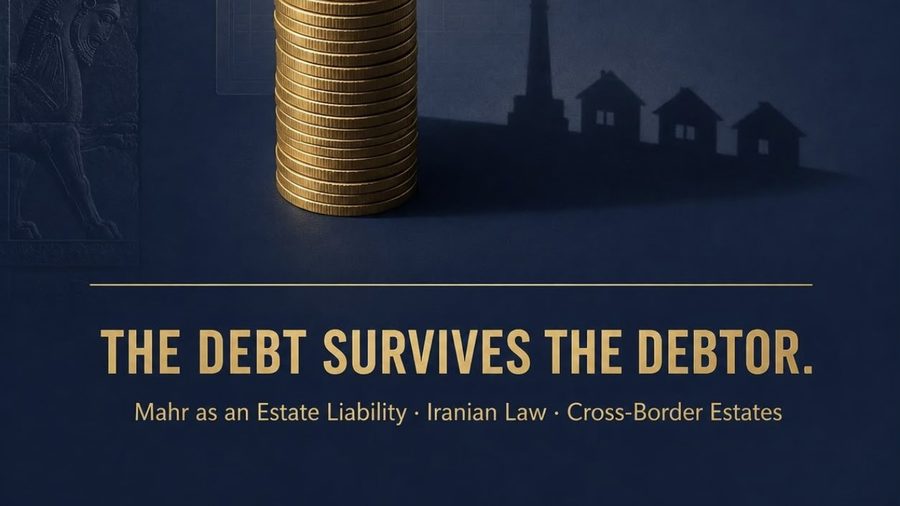
An Iranian entrepreneur dies abroad. In Iran: no assets at all. Where he lived: a factory and three houses. His widow turns to the children and claims her mahr — 600 Bahar-e Azadi gold coins. At today's gold price, roughly half a million euros.
The file lands on a desk in Frankfurt, London, Sydney or Los Angeles. The local procedure is rarely the hard part. The Iranian layer underneath it is.
The debt does not die with the debtor
Mahr is not a symbol and not a wedding gift. It is a real obligation of the husband, and on his death it becomes a liability of the estate. Under Iranian succession law the heirs' title does not settle until the deceased's debts are paid (Arts. 868, 869 Iranian Civil Code). So the widow wears two hats at once: creditor for the 600 coins, and heir to her one-eighth on top. Neither cancels the other.
The "110 coins" argument usually misses
The other side almost always invokes the 110-coin ceiling in Iranian family law and treats it as a cap on the claim. It is not. That provision limits a coercive enforcement mechanism against a living debtor. It does not extinguish the obligation itself. Against an estate, all 600 coins are on the table.
One word in the marriage contract decides the burden of proof
Ind-al-motalebe (payable on demand) or ind-al-estetaa (payable according to means): two clauses, two entirely different evidential positions. Add the question of which date governs the conversion of coins into euros or dollars, and half a million is being negotiated on assumptions.
In a common-law court, "proved" is a technical word
Foreign law is not something a judge is presumed to know. It has to be pleaded and established — sources, translation, traceability. Where it is not, a court may presume the foreign system resembles its own. Applied to fixed heirship shares and a mahr that behaves like a debt, that does not give you an approximate answer. It gives you the wrong one.
The local proceeding stays with local counsel. That does not change. The Iranian legal layer is my part of the file: opinions on Iranian law, documents obtained from Iran, calculation, second opinions.
One legal system is never enough.
##IranianLaw ForeignLaw ExpertEvidence ExpertWitness CrossBorderLitigation PrivateInternationalLaw ConflictOfLaws InternationalFamilyLaw SuccessionLaw Probate TrustsAndEstates EstateLitigation FamilyLaw PrivateClient ARIKEH