Digital assets
Is Crypto Halal? It Is Not One Question. It Is Four.
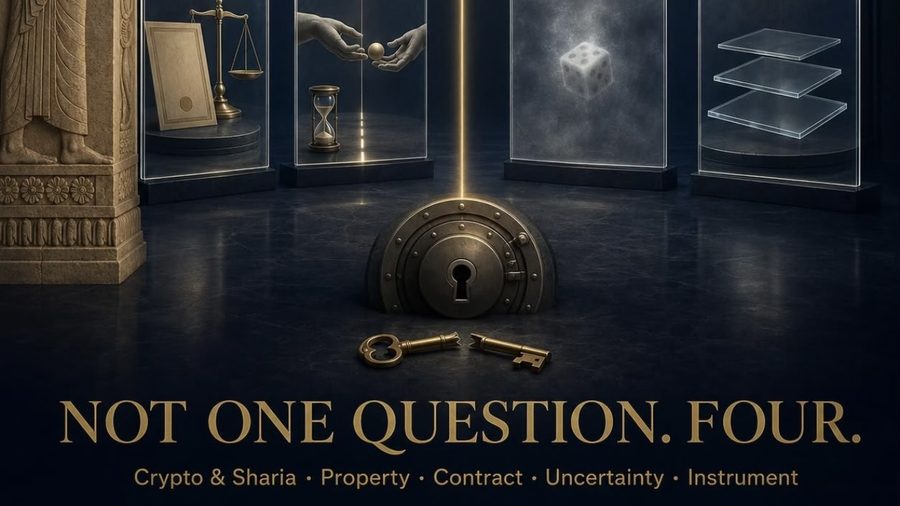
I am asked this in Dubai, in Riyadh, and increasingly in Frankfurt. What follows is usually an argument — because the question does four jobs at once, and the people disagreeing are often answering different ones.
That framing is not mine. In Resolution 237 (8/24) on electronic currencies, the OIC's International Islamic Fiqh Academy issued no ruling. It asked what a cryptocurrency actually is — a product, a benefit, an investment asset, a digital asset — and whether Sharia treats it as real value and tradable. Then it recommended further study.
One: is it property at all?
Is a token mal, capable of being owned and exchanged, and mal mutaqawwim, property the law recognises as having value? If it fails here, the analysis may end before the trading structure is ever reached.
Two: which contract are you in?
If the token is characterised as money, the rules of sarf may apply: countervalues exchanged with actual or constructive possession before the parties separate. If it is a commodity, a different framework governs.
Three: where do gharar and maysir sit?
Gharar is legally material uncertainty about the subject matter, essential terms, ownership or deliverability. Maysir is a wager-like structure where one side's gain depends on the other's loss without legitimate countervalue. Price volatility is not, by itself, contractual gharar.
Indonesia and Malaysia — both Shafi'i-majority — built materially different frameworks. Indonesia's MUI rejected crypto as a medium of exchange, and as a traded commodity where gharar, harm and the requirements of a valid sil'ah are unresolved — leaving a conditional exception for assets that meet them, have an underlying and give a clear benefit. Malaysia's Securities Commission went structured: rights and benefits, use of proceeds, underlying assets, and whether it trades on a registered exchange.
Four: what instrument sits on top?
Spot is not margin. Margin is not a derivative. Much of the disagreement dissolves once someone says which layer they mean.
And the one almost nobody asks: after death?
Under the classical Islamic succession framework — reflected in Article 193 of the UAE Personal Status Law — heirs take fixed shares, and a bequest beyond one third stands only so far as the heirs approve it, subject to the applicable law. None of it helps if the private key died with the owner. Legal entitlement is not practical ability — and no fatwa recovers a lost key.
I am a lawyer, not a mufti. My work is not the ruling; it is keeping the legal, the fiqh and the technical layer from being mistaken for one another. Much of the apparent disagreement here is not about the answer. It begins earlier: with what question is actually being asked.
##IslamicFinance Sharia DigitalAssets CryptoRegulation UAE Inheritance EstatePlanning ARIKEH IslamicLaw Fiqh Crypto Tokenization GCC CrossBorder Compliance